

Contents
- 1 The 50 Non-Negotiable Points Every Franchisor Must Reveal Before Selling a Franchise
- 1.1 What Is a Franchise Disclosure Document (FDD)?
- 1.2 Here i mention 50 Points that is must for Franchise
- 1.3 Brand & Company Details
- 1.4 Brand & Business Model Clarity
- 1.5
- 1.6 Franchise History & Track Record
- 1.7 Financial Disclosures
- 1.8 Location & Territory Rights
- 1.9 Operations & Support System
- 1.10 Legal Terms, Exit & Protection
- 1.11 Why FDD Is Critical in India (Even Without Legal Mandate)
- 1.12 Final Words from FranchiseBatao
The 50 Non-Negotiable Points Every Franchisor Must Reveal Before Selling a Franchise
Franchising is one of the fastest and smartest ways to Expand a business in India. But at the same time, it is also one of the most misunderstood business models.
At FranchiseBatao, we have seen hundreds of franchise disputes—not because the idea was bad, but because clarity was missing at the time of Purchasing of Franchise
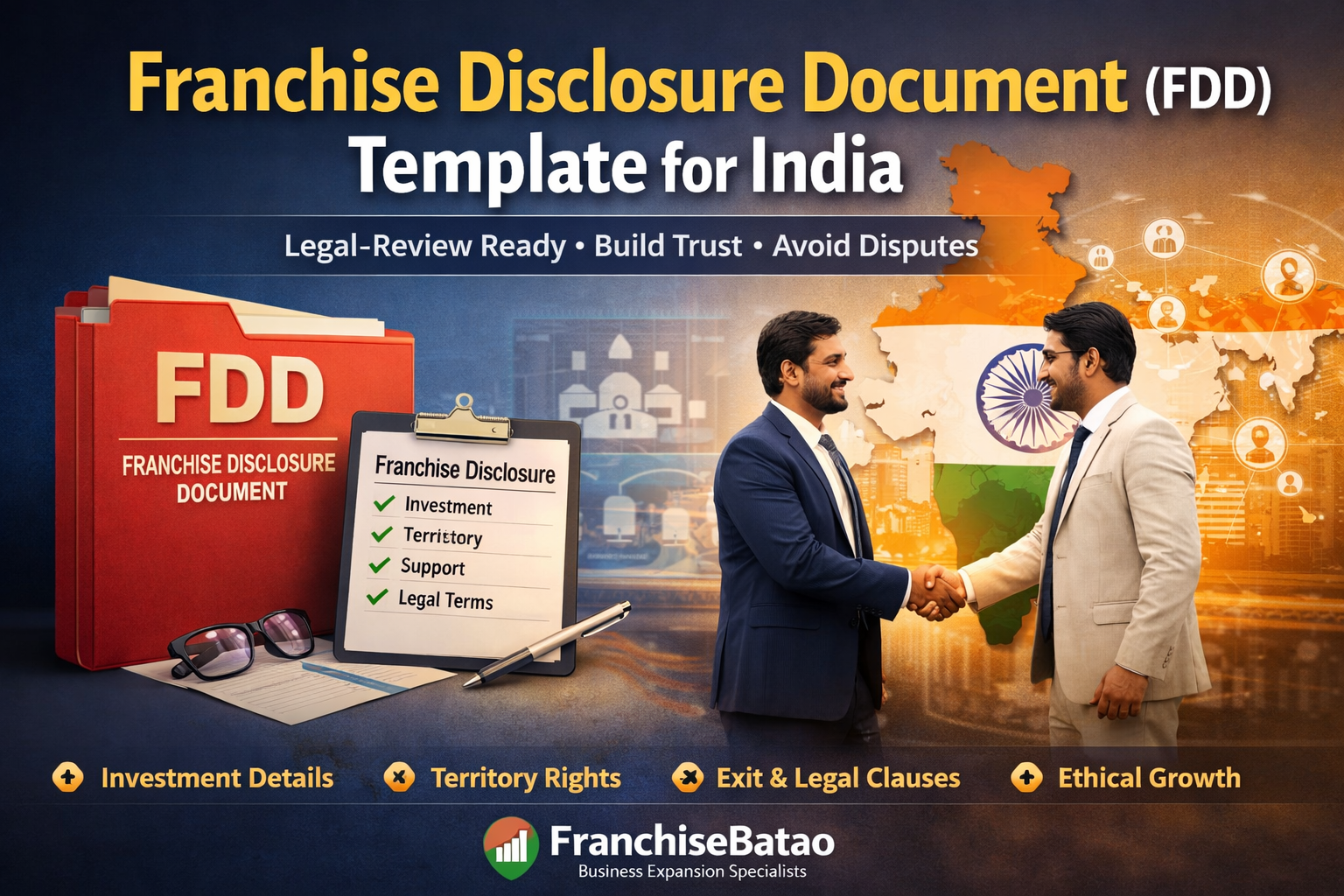
This is where a Document is must where all about Franchise must be there called Franchise Disclosure Document (FDD)
Although India does not legally mandate an FDD like the USA, a strong FDD is the backbone of a trustworthy, scalable, and long-lasting franchise brand.
Here we break down the 50 must-have points that every franchise disclosure document must include before selling a franchise.

What Is a Franchise Disclosure Document (FDD)?
A Franchise Disclosure Document is a transparent, written Document that clearly explains:
-
Who the franchisor is (The Person / Copmpany Selling the Franchise)
-
How the franchise business works
-
What investment is required to start the Franchise in detail
-
What support will be provided to the Franchise
-
What risks, responsibilities, and exit options exist at the agreement
FDD protects both the franchisor and the franchisee.
Here i mention 50 Points that is must for Franchise
Brand & Company Details
Every franchise buyer first invests in people / Company and credibility, not just a brand.
Your FDD must clearly mention:
-
Legal name of the franchisor company
-
Company registration details (CIN / LLP / Proprietorship)
-
Year of incorporation
-
Registered office and corporate address
-
Background of promoters/directors
-
Business experience of founders
-
Details of group companies or sister concerns (if any)
This section will build trust and authenticity of the brand
Brand & Business Model Clarity
A franchise is not just a logo—it’s a replicable business system.
Your FDD should explain
-
Brand concept and business idea
-
Unique Selling Proposition (USP)
-
Target customer profile
-
Business category (Food, Retail, Service, Education, etc.)
-
Business format (FOFO, COCO, Hybrid)
-
Long-term scalability vision
-
Ideal franchisee profile
This ensures alignment between brand expectations and franchisee capability.

Get Franchise Business Consulting from Ashish Kumar Agarwal , Founder of Franchise Batao
Franchise History & Track Record
This is where maximum manipulation happens, and hence maximum clarity is required.
-
Years of franchising experience
-
Total number of operational franchise units
-
Number of company-owned outlets
-
Presence across cities and states
-
Closed or failed franchise units with reasons
Hiding failures kills brands faster than failures themselves.
Financial Disclosures
this is why a person is buying Franchise. so Money Clarity is Mandatory
-
Total investment range
-
Complete investment breakup
-
Initial franchise fee
-
Royalty structure (percentage/fixed/zero)
-
Marketing or brand fund charges
-
Any other recurring or hidden costs
-
Working capital requirement
-
Expected monthly operating expenses
-
Expected revenue range
-
Expected profit margin (conservative)
-
Expected break-even period
Always include a disclaimer: profits are indicative, not guaranteed
Location & Territory Rights
Most franchise buyers have territory confusion, so clearly mention the area rights
-
Minimum area requirement
-
Preferred location type
-
Location approval process
-
Territory exclusivity (Yes/No)
-
Minimum distance clause between two franchise outlets
Operations & Support System
A franchise is successful only if support is real, not promised verbally.
Your FDD should explain:
-
Pre-launch support provided
-
Training details (duration, location, cost)
-
SOPs and manpower support
-
Supply chain and vendor dependency
-
Billing, POS, or software support
-
Marketing and launch support
-
Frequency and type of ongoing support
Strong support systems create brand consistency.
Legal Terms, Exit & Protection
This section protects both sides during tough times.
Mandatory disclosures include:
-
Franchise agreement tenure
-
Renewal terms and renewal fees
-
Franchisee obligations
-
Franchisor obligations
-
Termination clauses (both sides)
-
Exit, resale, or transfer rights
-
Dispute resolution method and jurisdiction
-
Non-compete and confidentiality clauses
Why FDD Is Critical in India (Even Without Legal Mandate)
In India:
-
Franchises fail due to over-promising at the time of selling
-
Legal disputes arise due to verbal commitments and misunderstandings
-
Brands collapse due to lack of documentation and clarity
A strong FDD ensures:
-
Higher-quality franchise partners
-
Faster brand scalability
-
Lower legal risk
-
Long-term brand reputation
Final Words from FranchiseBatao
A franchise should be sold with confidence, not confusion.
If you are a franchisor planning to expand—or an entrepreneur planning to buy a franchise—never proceed without a complete Franchise Disclosure Document.
Want Help?
At FranchiseBatao, we help brands:
-
Create professionally drafted FDDs
-
Build ethical and scalable franchise models
-
Educate franchise buyers with clarity
Comments are closed, but trackbacks and pingbacks are open.