

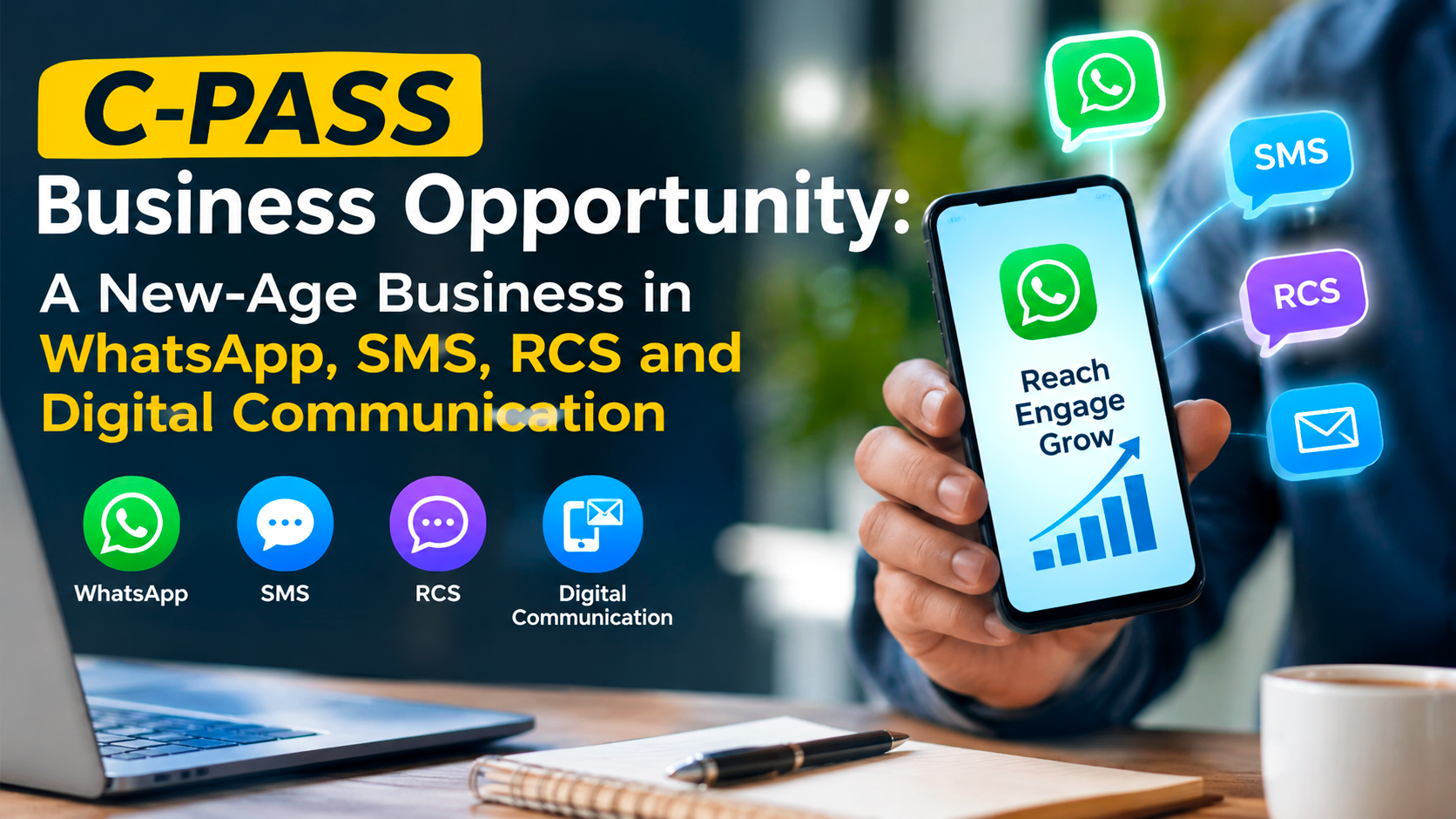
In today’s business environment, marketing is no longer limited to newspaper advertisements, hoardings or traditional promotions. Businesses are using Google Ads, Instagram, Facebook, WhatsApp, SMS and many other digital channels to reach their customers.
But one thing has not changed — a business needs to communicate with its customers.
Whether it is an education consultant following up with students, a real estate company contacting property buyers, a restaurant announcing an offer or a doctor reminding patients about an appointment, communication plays an important role in converting enquiries into customers.
This is where C-PASS, or Communication Platform as a Service, comes into the picture.
In a recent business podcast conversation with Rohit Raghav, Founder and CEO of WebTech Edge Private Limited, C-PASS was discussed as a platform that brings communication services such as WhatsApp, SMS and RCS together, along with voice calling, IVR and cloud call centre solutions.
This blog also looked at C-PASS as a possible white-label business opportunity for entrepreneurs, digital marketers, IT professionals and people who want to start a technology-based service business.
What Is C-PASS?
C-PASS stands for Communication Platform as a Service.
In simple Indian business language, you can understand it as a platform that helps a business manage different customer communication services from one place.
Normally, a company may use one platform for SMS, another for WhatsApp, another system for calling and perhaps another software for managing its sales team.
This creates a lot of manual work.
For example, a company sends an SMS campaign and then downloads the delivery report. It may then take the failed numbers and use another platform to send WhatsApp or RCS messages.
C-PASS attempts to bring these communication requirements into a more connected system.
The idea discussed in the podcast is to make customer communication more systematic instead of making businesses manage every communication channel separately.
And this is where the concept becomes interesting for both business owners and entrepreneurs.
Why Do Businesses Still Need SMS When Everyone Uses WhatsApp?
This is probably one of the first questions that comes to mind. Today, almost every business is using WhatsApp in some form. So, does SMS still have any value?
The answer is yes. WhatsApp, SMS and RCS serve different communication requirements.
For example:
- SMS can be used for alerts, notifications and transactional communication.
- WhatsApp is useful for customer conversations and engagement.
- RCS can provide a richer visual messaging experience.
- Voice calls can help businesses follow up with leads.
- IVR can help businesses manage customer calls.
- Cloud call centre solutions can improve sales-team productivity.
The podcast discussion also highlighted that SMS continues to have an important role, particularly in transactional communication such as banking and service notifications.
So, instead of asking whether SMS or WhatsApp is better, businesses should ask:
Which communication channel is best for which customer and which purpose?
That is a much more practical approach.
C-PASS and WhatsApp Business API
Another important part of the C-PASS business model is WhatsApp Business API. But before understanding the API, it is important to understand that normal WhatsApp, WhatsApp Business and WhatsApp Business API are different things.
Normal WhatsApp
Normal WhatsApp is mainly designed for personal communication. People use it for chatting, calls, groups, status updates and personal conversations.
WhatsApp Business
WhatsApp Business provides additional features for businesses. For example, a small shop or service provider can create a business profile and showcase products or services.
WhatsApp Business API
WhatsApp Business API is designed for more structured business communication and integration.
Businesses can use it for communication workflows, customer notifications and other commercial use cases, subject to WhatsApp’s policies and requirements.
The source discussion specifically explains the importance of using the appropriate commercial WhatsApp system instead of treating normal WhatsApp as a bulk marketing tool.
For businesses managing a large customer database, an API-based system can make communication much more organised.
What Is RCS and Why Are Businesses Talking About It?
RCS means Rich Communication Services. If SMS is mostly text-based, RCS is designed to provide a richer communication experience.
Depending on the implementation, RCS can include:
- Brand name
- Brand profile
- Images
- Videos
- Call-to-action buttons
- Rich media
- Interactive communication
The podcast describes RCS as a richer communication format associated with Google’s messaging ecosystem. Think about a simple example. Suppose a restaurant wants to promote its weekend offer.
A normal SMS may simply say:
“Weekend Special Offer. Visit our restaurant today.”
A richer communication format can potentially show the brand, offer image and an action button.
Similarly, a real estate company can use richer communication to present a property, while an education company can share course information with an enquiry CTA.
How C-PASS Can Combine WhatsApp, SMS and RCS
The real idea behind C-PASS is not just offering three different communication products.
The bigger idea is combining communication channels into a workflow.
Let’s take a simple example.
Suppose a company has a database of 100,000 customers.
Instead of manually running separate campaigns on different platforms, a unified communication system can help the business manage campaigns and delivery-based communication more systematically.
The podcast discussion explains a model where failed communication from one channel can be followed by another communication channel as part of a campaign workflow.
This can save time for marketing teams and reduce repetitive manual work.
In simple words:
One customer database → Multiple communication channels → Better follow-up
That is the core idea.
Voice Calls and IVR: Communication Beyond Messaging
Customer communication does not end with WhatsApp or SMS.
Many businesses generate leads through:
- Google Ads
- Facebook Ads
- Websites
- Webinars
- Landing pages
- Offline campaigns
But getting a lead is only the first step.
The bigger challenge is following up with that lead.
Suppose a real estate company receives 1,000 enquiries.
Not every customer will reply to WhatsApp. Some may see an SMS but not respond. Some may not answer a normal call.
This is where voice communication and IVR can become useful.
Cloud Call Centre and Auto Dialer
Another interesting service in the C-PASS ecosystem is the cloud call centre.
Imagine a sales executive sitting with an Excel sheet containing hundreds of numbers.
He calls one person.
The call ends.
Then he searches for the next number.
Again, he calls.
This process takes time.
A cloud call centre with auto-dialling can make the process more systematic.
According to the podcast discussion, an auto-dialling system can automatically dial the next number after a defined gap and can also maintain customer and call-related information.
For businesses with large sales teams, this can potentially improve productivity and make sales activity easier to track.
Who can actually start a C-PASS business?
The model discussed in the podcast is based on a white-label communication platform.
White-label basically means that instead of developing the entire technology yourself, you can use an existing technology platform and offer it to your customers under your own business identity, depending on the provider’s terms.
The discussion describes a model where partners can use the platform with their own branding and domain.
This can be relevant for people already working in:
- Digital marketing
- Advertising
- SEO
- Website development
- Social media marketing
- Lead generation
- IT services
- Business consultancy
- Franchise consultancy
For such professionals, communication services can become an additional revenue stream along with their existing services.
Which Businesses Can Use C-PASS?
One major advantage of communication technology is that almost every industry needs customer communication.
Education and Admission Consultants
Education businesses continuously communicate with students and parents.
They need to share:
- Course information
- Admission updates
- Counselling details
- Fee information
- Follow-up messages
- Application reminders
The podcast includes a case example of an admission-focused company that used SMS, WhatsApp, and RCS for its counselling and lead-follow-up process. The numbers mentioned in the conversation are the company’s reported experience and should not be treated as independently audited results.
Real Estate Businesses
Real estate is another industry where communication is extremely important.
A real estate company can potentially use these services for:
- New project announcements
- Property enquiries
- Site-visit reminders
- Lead follow-ups
- Offers
- Existing lead reactivation
Real estate leads often require multiple follow-ups before conversion, which makes systematic communication particularly useful.
Doctors and Clinics
Doctors, dentists and clinics also need customer communication.
The podcast discusses a dentist-related campaign involving geo-targeted communication and a free check-up campaign. The results mentioned are presented as a case example from the conversation, not as independently verified statistics.
For local businesses, reaching people in a relevant geographical area can be useful for promotions and awareness campaigns, subject to applicable privacy and marketing regulations.
Restaurants and Local Businesses
Restaurants can also use customer communication for:
- Festival offers
- New menu launches
- Special discounts
- Customer engagement
- Repeat visits
- Local promotions
For a restaurant, communicating with existing customers can sometimes be more useful than continuously trying to acquire completely new customers.
Why Is the White-Label C-PASS Model Interesting?
Building communication technology from scratch is not a small task.
It requires:
- Software development
- Server infrastructure
- API integrations
- Maintenance
- Technical support
- Security
- Updates
A white-label model allows the entrepreneur to focus more on sales and customer relationships, while the technology infrastructure is provided by the technology partner.
The business owner can focus on:
- Finding customers
- Understanding customer requirements
- Selling communication services
- Providing support
- Building long-term customer relationships
The podcast describes WebTech Edge’s model as a white-label application that partners can use under their own branding and domain.
However, the exact commercial terms, pricing and partner conditions should always be checked directly with the service provider before making any investment decision.
No business opportunity is automatically profitable for everyone.
Having access to technology does not mean that customers will automatically come.
A person entering the C-PASS business still needs to know:
- How to generate leads
- How to sell
- How to approach businesses
- How to explain the product
- How to retain customers
- How to provide customer support
- How to run marketing campaigns
C-PASS vs Traditional Digital Marketing
C-PASS and digital marketing should not necessarily be considered competitors. In fact, they can work together.
A modern customer journey may look something like this:
Google Ads → Lead Generation → CRM → WhatsApp → SMS/RCS Follow-up → Voice Call → Sales Team → Conversion
- Social media and advertising help bring attention.
- Lead-generation campaigns bring enquiries.
- CRM helps organise the leads.
- Communication platforms help businesses follow up.
- The sales team then works towards conversion.
So the real opportunity is not simply “WhatsApp marketing”.
The Entrepreneurial Story Behind C-PASS
The podcast is not only about technology. It also talks about the entrepreneurial journey of Rohit Raghav.
According to the discussion, his journey involved working in sales, learning digital marketing, exploring telecom-related opportunities and eventually building experience in SMS, voice and IVR solutions.
One practical lesson from this journey is that entrepreneurs do not always start with everything figured out.
Skills can be learned. Technology can change. Markets can change. But the ability to learn, sell and adapt remains important.
This is especially true in the digital business sector.
What Is the Future of Business Communication?
The future of communication is unlikely to be only WhatsApp. It is more likely to be multi-channel communication.
A customer may discover a company through Instagram, visit its website through Google, submit a form, receive a WhatsApp message, get an SMS reminder, receive an RCS campaign and finally speak to a salesperson.
As digital marketing becomes more competitive, businesses will need not only to generate leads but also to manage and nurture those leads properly.
That is where communication platforms like C-PASS can potentially play an important role.
Conclusion: Should You Explore the C-PASS Business Opportunity?
C-PASS is an interesting concept because it brings several business communication requirements under one broader platform.
WhatsApp, SMS, RCS, voice calling, IVR and cloud call centre services can all have different roles in a company’s marketing and sales process.
For entrepreneurs, the white-label model can be particularly interesting because it may allow them to enter the digital communication services industry without developing the entire technology infrastructure themselves.
Frequently Asked Questions About C-PASS
What is C-PASS?
C-PASS stands for Communication Platform as a Service. It is a technology-based communication model that can bring multiple customer communication services into one platform.
What services are included in C-PASS?
Depending on the provider, C-PASS solutions can include WhatsApp Business API, SMS, RCS, voice calls, IVR and cloud call centre services.
Is C-PASS the same as WhatsApp Business?
No. WhatsApp Business is a Meta product, while C-PASS is a broader communication platform concept that can include multiple communication channels.
Who can start a C-PASS business?
Digital marketing agencies, IT companies, advertising professionals, consultants, lead-generation companies and other entrepreneurs may find the white-label model relevant, depending on the provider’s partner programme.
Can C-PASS be used by small businesses?
Yes, communication platforms can be useful for small businesses as well, but the services and budget should be selected according to the actual business requirement.
Is SMS still relevant in 2026?
Yes. SMS continues to have applications in transactional, notification and service-related communication, even as newer channels such as WhatsApp and RCS grow.
Is C-PASS a guaranteed income opportunity?
No. Like any business opportunity, results depend on sales, customer acquisition, marketing, execution and the commercial terms of the programme.
What should I check before investing in a C-PASS franchise?
Check the investment, recurring charges, message pricing, margins, technical support, white-label rights, renewal terms, compliance requirements and customer acquisition expectations before investing.
Comments are closed.