

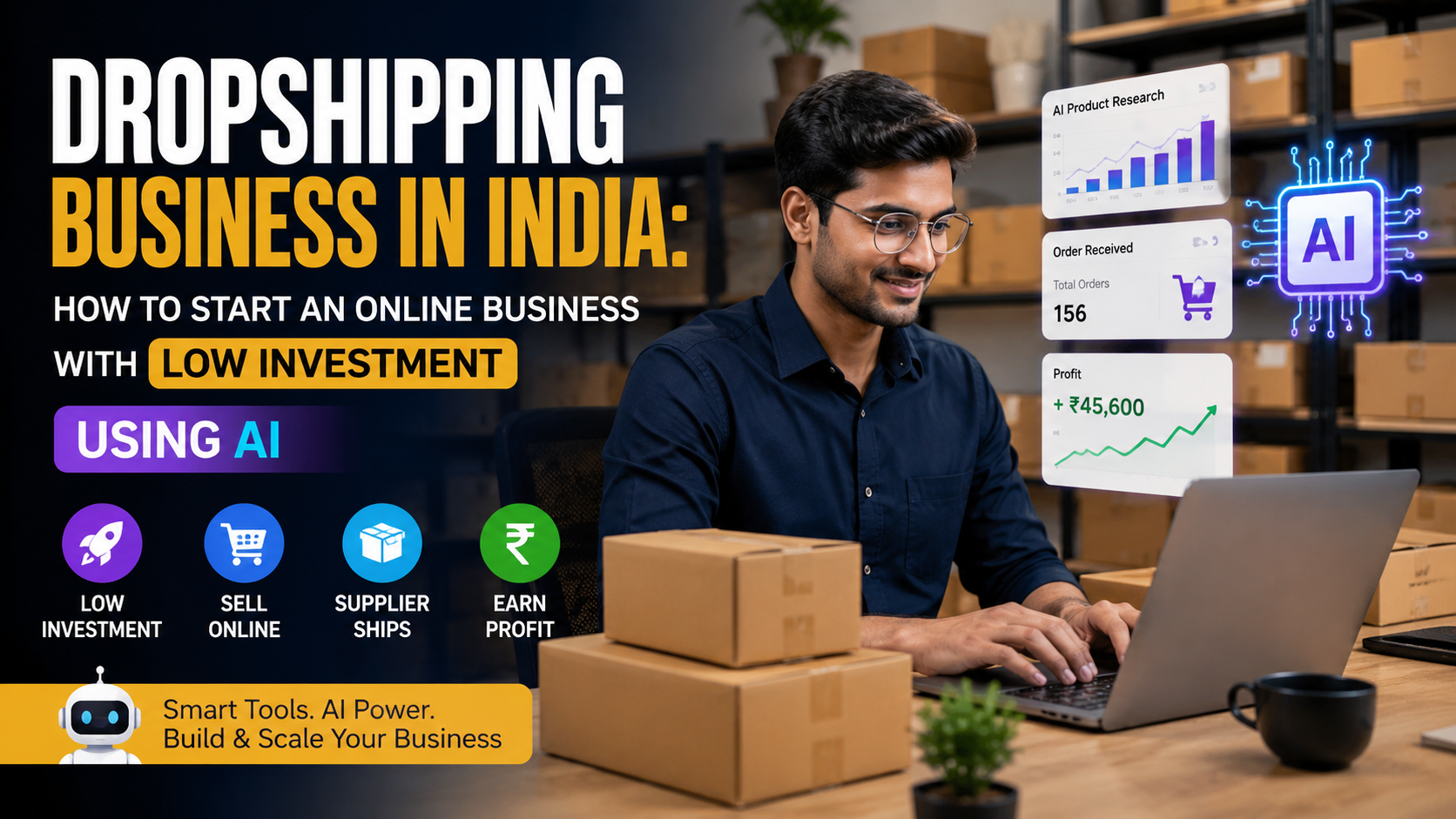
Starting a business in India is no longer limited to opening a shop, renting a showroom, or investing heavily in stock. The way people start and grow businesses has changed significantly with smartphones, social media, e-commerce, and artificial intelligence.
Today, a person with a smartphone, the right skills, and a practical business approach can explore several online business opportunities without immediately investing a large amount in inventory.
One model that has attracted considerable attention is the dropshipping business in India.
But there is a lot of confusion around dropshipping. Some people believe it means making easy money without investment, while others think it can automatically generate lakhs of rupees every month.
Dropshipping can be a useful way to understand ecommerce, test products and learn online selling with relatively lower inventory risk. However, success still depends on product selection, marketing, customer trust, website experience, fulfilment and consistent execution.
What Is Dropshipping?
Dropshipping is an ecommerce business model where the seller does not necessarily keep the products in their own inventory.
- You select products that you want to sell.
- You promote those products through your website or digital channels.
- A customer places an order.
- The supplier or fulfilment partner handles the product dispatch.
- You earn the difference between your selling price and your applicable costs.
This makes dropshipping different from the traditional retail model, where a business owner normally purchases and stores inventory before selling it.
The biggest attraction is therefore lower inventory risk.
However, lower inventory risk does not mean zero business risk.
You still need to spend time on product research, content, customer acquisition, website optimisation, customer support and business learning.
Is Dropshipping Profitable in India?
Yes, dropshipping can be profitable, but profitability depends on the complete business model rather than simply selling products online.
A common mistake is to look at revenue and ignore margins.
For example, if a business generates ₹10 lakh in sales but has high advertising, shipping, returns, payment and operational costs, the actual profit can be much lower.
The podcast discussion makes the same distinction between revenue and profit and explains that business owners need to understand the mathematics behind their sales before assuming that a particular revenue number means a particular income.
So, before starting a dropshipping business, calculate:
Revenue – Product Cost – Marketing Cost – Shipping – Returns – Payment Charges – Other Expenses = Actual Profit
This simple calculation can save a business owner from many unrealistic expectations.
Can You Start a Dropshipping Business with Low Investment?
One of the biggest advantages of dropshipping is that you can start by testing products without purchasing large quantities of inventory.
The podcast suggests using dropshipping as a way to test the market before moving into larger-scale production or brand building.
For a beginner, this approach can be useful:
Learn → Select a product → Test demand → Get customer feedback → Improve → Scale
Instead of immediately investing heavily in manufacturing or stock, entrepreneurs can first understand whether customers are actually interested in a product.
But remember: low investment is not the same as no investment.
You may still need money for:
- Website and domain
- Product samples
- Content creation
- Marketing
- Payment systems
- Customer support
- Packaging or fulfilment
- Business registration and compliance, where applicable
How to Start a Dropshipping Business in India
1. Choose a Specific Product Category
Do not start by trying to sell everything.
Choose a category based on:
- Customer demand
- Competition
- Product quality
- Selling price
- Profit margin
- Shipping feasibility
- Return risk
- Content potential
A focused category also makes it easier to build a recognisable brand.
For example, instead of selling fashion, electronics, beauty products and home products together, a beginner could start with one clearly defined niche.
2. Test Products Before Scaling
One of the biggest lessons from the podcast is to test before making a large investment.
If you are thinking about manufacturing your own product, dropshipping or small-scale online selling can help you understand customer behaviour first.
If people are repeatedly showing interest in one category, that data can later help you decide whether to invest in inventory, private labelling or your own brand.
3. Build a Professional Website
Social media is excellent for awareness, but a professional website can become the central asset of an online business.
Your website should clearly communicate:
- What you sell
- Why customers should trust you
- Product benefits
- Pricing
- Delivery information
- Return/refund policy
- Contact information
- Social media presence
- Customer reviews, wherever genuine and permitted
A website should not look like a temporary product page created only to run advertisements.
It should create confidence.
The podcast also highlights the importance of checking a seller’s online presence before trusting an unfamiliar online business.
4. Build Trust Before Trying to Scale
Online customers are increasingly careful about where they purchase products.
Before ordering from an unfamiliar brand, customers may check:
- YouTube
- Website
- Reviews
- Brand history
- Product demonstrations
- Contact information
This is why brand trust and digital presence are important parts of ecommerce marketing.
A business that consistently publishes useful content can gradually build credibility instead of depending entirely on paid advertising.
Why Social Media Is Important for an Online Business
Instagram, YouTube, Facebook and other platforms have changed the way small businesses reach customers.
A local manufacturer can now show its products to customers outside its city.
A shopkeeper can demonstrate products through short videos.
A creator can build an audience around a specific skill.
A manufacturer can show how products are made.
This creates an important opportunity for small businesses: content can become a distribution channel.
The podcast repeatedly discusses the importance of showing your product, expertise and business online instead of waiting for customers to physically discover you.
The basic formula is simple:
Create useful content → Build trust → Attract the right audience → Convert interested customers
Performance Marketing vs Organic Marketing
Performance marketing can help businesses reach their growth targets faster, but it should not be considered the only way to build a business.
Performance marketing is particularly useful when a company already has a product, website, offer and conversion system and wants to scale customer acquisition.
The podcast explains that businesses often turn to performance marketing when they want to grow much faster than organic content alone may allow.
However, paid advertising cannot fix everything.
If your:
- Product is poor
- Website is confusing
- Offer is weak
- Customer trust is low
- Delivery experience is bad
- Return process is difficult
then increasing the advertising budget may simply increase the number of people experiencing those problems.
That is why marketing should be treated as one part of the complete business system.
How AI Is Changing Ecommerce and Online Business
Artificial intelligence is becoming an important part of modern business operations.
Today, AI tools can assist entrepreneurs with areas such as:
- Market research
- Content ideas
- Product descriptions
- Ad copy
- Customer communication
- Social media planning
- Data analysis
- Workflow automation
- Customer support
- Creative development
The podcast strongly focuses on AI as a business-enabling technology rather than something entrepreneurs should simply fear.
For an ecommerce entrepreneur, AI can reduce the time required for repetitive tasks.
For example, instead of manually creating every product description, a business owner can use AI to create a first draft and then review and improve it.
Similarly, AI can help organise customer questions, generate content ideas and support marketing workflows.
But AI does not remove the need for human decision-making.
Someone still needs to understand:
- The customer
- The product
- The market
- The brand
- Business economics
- Customer experience
AI should therefore be treated as a productivity tool, not as a replacement for business understanding.
AI and Marketing Automation
Automation becomes especially useful when an online business starts receiving more enquiries and orders.
Imagine a business receiving hundreds or thousands of customer enquiries every month.
Manually responding to every enquiry can become difficult.
AI-powered automation can assist with:
- Initial customer queries
- Follow-ups
- Lead qualification
- WhatsApp communication
- FAQs
- Product recommendations
- Appointment or enquiry scheduling
The podcast discusses AI agents, WhatsApp automation and the ability of automation systems to handle repetitive communication at scale.
The important point is that automation should improve the business process rather than simply be added because it is trending.
Will AI Replace Digital Marketing Jobs?
This is one of the biggest questions among business owners and marketers.
A better way to look at the situation is that AI is changing the type of work people do.
Repetitive tasks may increasingly become automated, while skills such as strategy, creativity, communication, analysis and implementation can become even more valuable.
For example, instead of spending hours creating a basic report, a marketer may use AI to generate the initial analysis and spend more time deciding what action the business should take.
The podcast also makes the point that AI adoption does not necessarily mean that human involvement disappears. People are still needed to manage systems, review quality, make decisions and implement business strategies.
So the better question is not:
“Will AI take my job?”
It is:
“How can I use AI to become better and faster at my job?”
Can AI Help You Start an Online Business?
Yes, AI can help at different stages of starting an online business.
For example, a beginner can use AI to brainstorm:
- Product categories
- Customer personas
- Content topics
- Website copy
- Marketing messages
- Frequently asked questions
- Email or WhatsApp communication
- Ad concepts
The podcast specifically discusses using AI tools to research a business, understand products and audiences, and develop marketing ideas.
However, AI-generated information should always be reviewed.
AI can provide suggestions, but the entrepreneur must verify whether those suggestions make commercial sense.
Dropshipping vs Building Your Own Brand
Dropshipping can be a useful starting point, but it does not necessarily have to be the final destination.
A possible business journey can look like this:
Dropshipping → Product Testing → Customer Data → Best-Selling Product → Private Label → Own Brand → Ecommerce Scale
Once you identify a product category that has genuine demand, you can consider developing your own products.
The podcast also discusses the idea that a brand does not necessarily need a huge catalogue from day one. Starting with a small number of focused products can make it easier to understand what works before expanding.
Why Focusing on One Niche Can Be Better
Many new entrepreneurs make the mistake of trying to sell everything.
But a focused niche can make marketing easier.
Suppose you start a women’s ethnic fashion brand.
Your content can focus on:
- Styling
- Fabrics
- Trends
- Product education
- Fashion tips
- Customer stories
Over time, customers can start remembering your brand for a particular category.
This is much stronger than becoming another generic online store selling hundreds of unrelated products.
The Importance of Product Quality
One of the biggest challenges in dropshipping is maintaining product quality.
You may not manufacture the product yourself, but the customer will still associate the product experience with your brand.
Therefore, before promoting a product at scale:
- Check samples
- Verify suppliers
- Understand specifications
- Test packaging
- Check delivery experience
- Understand return policies
- Monitor customer feedback
Never assume that a product will sell simply because it is trending.
A trending product with poor quality can create negative reviews, refunds and customer complaints.
COD, Returns and Ecommerce Profitability
Cash on Delivery has played an important role in Indian ecommerce, but COD can also create operational challenges.
Returns, cancellations and failed deliveries can affect margins.
The podcast discusses how COD-related returns and logistics costs can create pressure on ecommerce profitability.
This is why ecommerce businesses should monitor metrics such as:
- Conversion rate
- Average order value
- Customer acquisition cost
- Return rate
- Cancellation rate
- Repeat purchase rate
- Gross margin
- Contribution margin
A business should not judge success only by the number of orders.
The real question is:
“After all costs, how much money is the business actually making?”
Common Dropshipping Mistakes Beginners Should Avoid
Chasing Every Trending Product
A product trending on social media does not automatically mean it will be profitable for you.
Spending Too Much on Ads Too Early
Test your product, offer and audience before aggressively increasing your advertising budget.
Ignoring the Website
A poor website can reduce customer trust and conversions.
Copying Competitors
Your business needs a reason for customers to choose you.
Ignoring Customer Experience
Fast selling is not enough. Delivery, support and returns matter.
Expanding Too Quickly
A product that sells well does not mean you should immediately launch ten more categories.
Expecting Overnight Success
Online business still requires learning, testing, consistency and patience.
A Practical Roadmap for Starting an Online Business
If you are a beginner, you can follow this simple roadmap:
Step 1: Choose one category.
Step 2: Research potential products.
Step 3: Understand your target customer.
Step 4: Test products with a low-risk approach.
Step 5: Create professional product content.
Step 6: Build a trustworthy website.
Step 7: Start organic social media content.
Step 8: Test paid marketing carefully.
Step 9: Track sales, margins and customer behaviour.
Step 10: Automate repetitive processes.
Step 11: Identify your best-performing product.
Step 12: Consider building your own brand around the winning category.
This approach is more sustainable than simply searching for a “quick money” business idea.
What Is the Future of Online Business in India?
The future of business is likely to become increasingly digital.
Customers are discovering products through social media, search engines, videos, creators and online communities.
At the same time, AI is making many business processes faster.
This does not mean traditional businesses will disappear.
Instead, traditional businesses that adopt digital tools can gain new opportunities.
A local manufacturer can create videos.
A retailer can sell online.
A service provider can generate leads through social media.
A small business can use automation for customer communication.
A creator can monetise expertise.
The technology is changing, but the fundamentals remain the same:
Good product + customer trust + useful marketing + consistent execution = sustainable business growth.
Final Thoughts
Starting an online business in India has become more accessible, but accessibility should not be confused with easy success.
Dropshipping can be a practical way to learn ecommerce and test products without immediately carrying large inventory. AI can make research, content creation, marketing and automation more efficient. Social media can help even small businesses reach customers beyond their local market.
But none of these tools can replace learning and implementation.
The most important lesson is simple: learn first, test practically, understand your numbers and then scale.
As the podcast concludes, entrepreneurs should keep educating themselves, understand what they are doing and implement the right things instead of chasing every new trend.
The opportunity is not simply in dropshipping or AI.
The real opportunity is in learning how to combine product, technology, marketing, automation and customer trust to build a sustainable business.
Frequently Asked Questions
Is dropshipping legal in India?
Dropshipping is a business model, but the business still needs to follow applicable Indian tax, consumer protection, ecommerce and other legal requirements depending on how it operates.
How much money is needed to start dropshipping?
There is no single fixed amount. A low-risk test can require considerably less capital than building a full ecommerce brand. Your actual requirement depends on your website, marketing, product testing and operational setup.
Can I start dropshipping without keeping inventory?
Yes. The basic concept of dropshipping is that the seller does not need to maintain traditional inventory in the same way as a conventional retailer.
Can AI help with dropshipping?
Yes. AI can assist with research, content, product descriptions, customer communication, marketing and automation. However, human review and business decisions remain important.
Is dropshipping better than building a brand?
They serve different purposes. Dropshipping can be useful for testing products and learning ecommerce, while building your own brand can offer greater control over products, positioning and customer experience in the long term.
Comments are closed.