

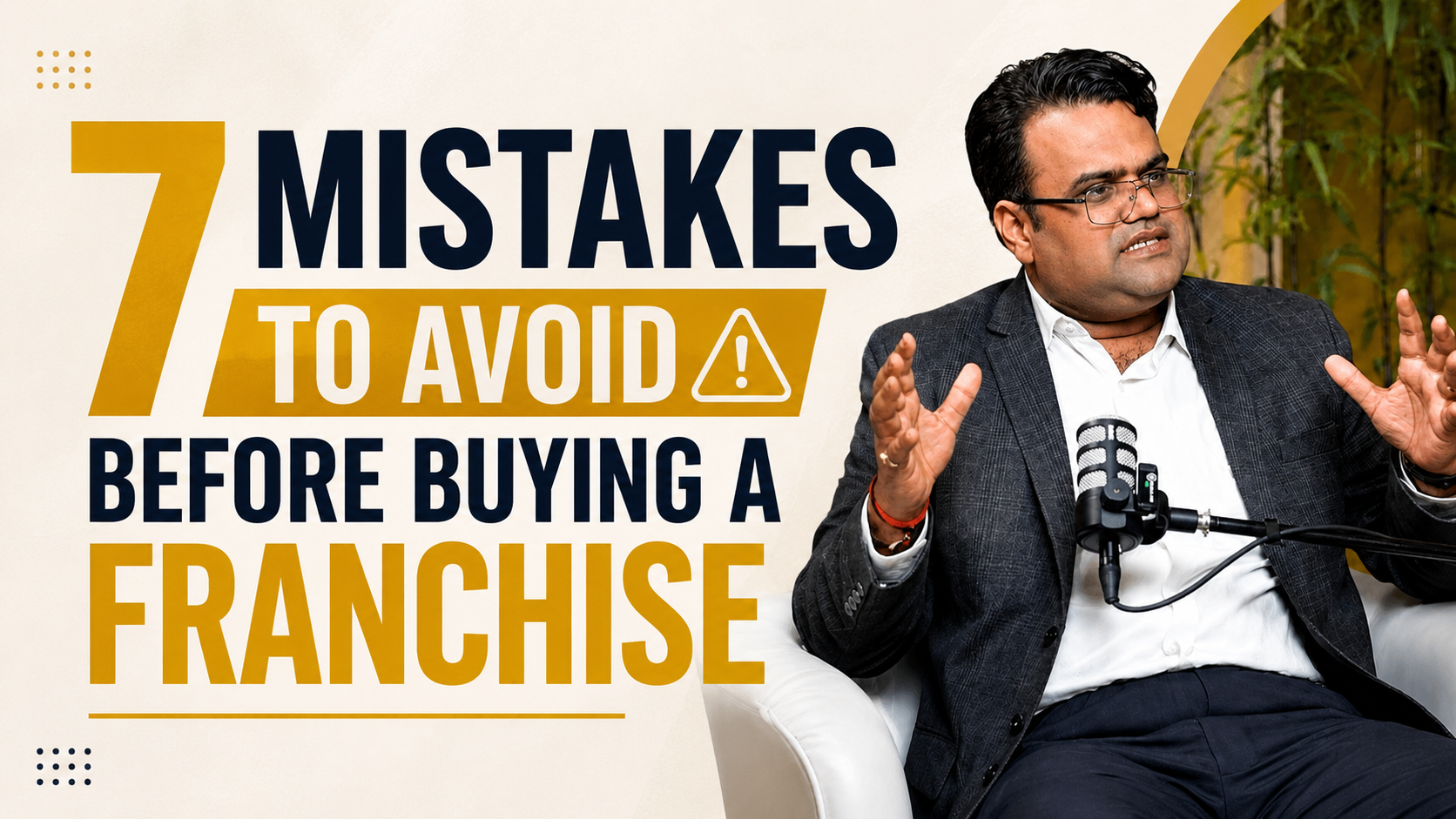
Buying a franchise can look like a safer way to enter entrepreneurship. You get an established brand, a business model, operating processes and, in many cases, training and support from the franchisor.
But there is an important point that every prospective franchise investor should understand:
A franchise is not a guaranteed-success business.
You are still investing your money, managing people, dealing with customers and operating in a competitive market.
In his conversation with Sarvesh Mishra, entrepreneur and business expansion expert Ashish Kumar Agarwal highlights several mistakes that investors should avoid before buying a franchise.
From assuming that a franchise is passive income to ignoring location economics and signing an agreement without understanding its terms, these mistakes can significantly affect the success of a franchise outlet.
Here are 7 franchise mistakes to avoid before investing your money.
-
Assuming a Franchise Means Passive Income
One of the biggest franchise misconceptions is that once you buy a franchise, the brand will take care of everything. That is rarely how a successful franchise business works.
A franchise may provide you with:
- Brand identity
- Training
- Standard operating procedures
- Products or raw materials
- Marketing support
- Technology
- Supply-chain systems
- Business processes
Someone needs to:
- Hire and manage employees
- Monitor daily operations
- Acquire customers
- Maintain service quality
- Control expenses
- Handle customer complaints
- Monitor local competition
- Track sales and profitability
Therefore, a franchise is still a business.
If your expectation is to invest money and receive guaranteed monthly income without being involved in the business, you may be approaching franchising with the wrong mindset.
Before investing, honestly ask yourself:
“Am I prepared to operate and manage this business?”
-
Buying a Franchise Only Because the Brand Is Famous
A famous brand can certainly provide an advantage. Customers may already recognise the name, trust the products and understand what the business offers. But brand recognition alone does not guarantee that your particular outlet will succeed. A brand can be extremely strong in one city and comparatively weak in another. India is a large and diverse market. Customer preferences, spending habits, competition and local demand can vary significantly from one location to another.
So don’t only ask: “Is this a famous franchise?”
Ask: “Is this brand strong in the market where I want to open my outlet?”
Study the brand’s performance in similar markets, existing outlets, customer reviews, pricing and local competition before making a decision.
-
Ignoring Local Customer Behaviour
A franchise business ultimately depends on customers in its specific market. This is why market research before buying a franchise is extremely important.
- Local customer demand
- Customer preferences
- Average ticket size
- Existing competitors
- Footfall
- Population profile
- Purchasing power
- Delivery radius
- Seasonality
- Local pricing
- Nearby businesses
For example, a food concept that performs exceptionally well in one city may not receive the same response in another city. The product itself may not be the problem. The issue could be pricing, taste preferences, customer profile, competition or purchasing power. Your local market deserves its own research.
-
Choosing the Wrong Franchise Location
Location can make or break a franchise business.
Even a strong brand can struggle if the outlet is difficult to access, has poor visibility or does not attract the right customers. When evaluating a franchise location, don’t look at rent alone.
Consider: Rent + Footfall + Visibility + Accessibility + Target Customer Density.
The real comparison should consider gross margin, staffing, utilities, marketing, delivery costs and other operating expenses. Therefore, location selection should be based on business economics, not simply the lowest rent.
Before finalising a property, visit the location at different times of the day and on different days of the week. Observe footfall, parking, visibility, accessibility and the type of people actually visiting the area.
-
Looking Only at the Franchise Fee
This is another common mistake made by first-time franchise investors. Suppose a franchisor tells you that the franchise fee is ₹10 lakh. Does that mean you need only ₹10 lakh? Definitely not necessarily.
The total investment may include:
- Franchise fee
- Interior and setup
- Equipment
- Security deposit
- Inventory
- Licences
- Technology
- Branding
- Pre-opening expenses
- Marketing
- Staff recruitment
- Working capital
- Contingency reserve
A useful formula is:
Total Franchise Investment = Franchise Fee + Setup Cost + Equipment + Deposit + Inventory + Working Capital + Marketing + Pre-opening Costs
A franchise with a ₹10 lakh franchise fee could ultimately require ₹25 lakh or ₹30 lakh—or more—depending on the business model and location. So, before paying the franchise fee, ask for a complete investment estimate. Don’t plan your investment around one number.
-
Ignoring Territory and Exclusivity Terms
Territory rights can have a major impact on the economics of a franchise.
Before signing, understand exactly what territory you are receiving.
Ask the franchisor:
- Is my territory exclusive?
- Can another franchise outlet open nearby?
- How is the distance between outlets decided?
- Can the franchisor sell directly in my territory?
- Can another franchisee target the same customers?
- How are online orders handled?
- What happens if another outlet starts affecting my sales?
If two outlets of the same brand are competing for the same customer base, sales can potentially get divided between them.
-
Not Reading the Franchise Agreement Properly
A franchise agreement is not just paperwork to complete after you have decided to invest. It defines important commercial and operational rights and responsibilities between the franchisor and franchisee. In India, there is no single umbrella law governing franchising. Invest India notes that different laws can apply to different aspects of a franchise arrangement, including contract, intellectual property, competition, consumer protection, taxation and labour-related matters.
Pay particular attention to:
- Franchise term
- Renewal conditions
- Franchise and royalty fees
- Marketing fees
- Territory rights
- Supply obligations
- Performance requirements
- Termination clauses
- Exit conditions
- Transfer or resale rights
- Dispute resolution
- Intellectual property provisions
- Non-compete or restrictive provisions
- Penalties and other financial obligations
The Indian Contract Act, 1872 provides the broader legal framework for contracts in India, while competition and intellectual-property laws can also become relevant depending on the arrangement.
Franchise Due-Diligence Checklist Before Investing
Before paying a franchise fee or signing the agreement, complete your own due diligence.
- Talk to Existing Franchisees
Don’t speak only to franchisees selected by the franchisor. If possible, speak with multiple franchisees and ask about their actual experience.
- Visit Multiple Outlets
Observe operations, customer footfall, staffing, cleanliness, product quality and customer behaviour.
- Understand Actual Unit Economics
Don’t rely only on projected returns. Understand sales, gross margin, operating expenses and realistic profitability.
- Calculate Total Investment
Include setup, deposit, equipment, inventory, marketing and working capital—not just the franchise fee.
- Understand Royalty and Recurring Fees
Check how much you will pay to the franchisor on an ongoing basis and what services you receive in return.
- Check Territory Rights
Understand whether your territory is exclusive and how nearby outlets will be handled.
- Study Supply-Chain Dependence
Find out whether you are required to purchase products or raw materials exclusively from the franchisor or approved suppliers.
- Verify Franchisor Support
Ask exactly what training, marketing, technology, recruitment and operational support is included.
- Examine Exit and Termination Clauses
Understand what happens if you want to exit, transfer the business or if the agreement is terminated.
- Take Professional Advice
Before committing substantial capital, consider independent legal and financial advice.
How to Decide Whether a Franchise Is Right for You
A franchise should not be evaluated on brand name alone.
Think of the decision as:
Brand + Market + Location + Economics + Your Capability
All five need to make sense together.
A strong brand with poor location economics can struggle.
A great location with weak customer demand can struggle.
A profitable business model can still fail if the franchisee does not have the ability or willingness to operate it properly.
And a good franchise opportunity may not be suitable for every investor.
The right franchise is one that fits your capital, skills, market, involvement level and long-term business goals.
Frequently Asked Questions About Buying a Franchise
What is the biggest mistake when buying a franchise?
One of the biggest mistakes is assuming that the brand’s success automatically guarantees the success of your outlet. The franchisee still needs the right market, location, execution and financial planning.
Is buying a franchise a passive investment?
Generally, a franchise should be treated as an operating business rather than automatically assuming it will generate passive income. The level of involvement depends on the business model and the agreement.
What should I check before buying a franchise?
Check the brand’s performance, local market demand, location economics, total investment, royalty and recurring fees, territory rights, supply chain, franchisor support, agreement terms and exit conditions.
Is the franchise fee the total investment?
No. The franchise fee is generally only one component of the overall investment. Setup, equipment, deposit, inventory, working capital, marketing and other costs may also apply.
Should I talk to existing franchisees before investing?
Yes. Speaking with existing franchisees can provide practical insights into operations, support, margins, challenges and the actual experience of running the business.
Should a lawyer review my franchise agreement?
For a significant investment, independent professional review can help you understand contractual obligations, risks, termination provisions and other important terms before you sign.
The key lesson from Ashish Kumar Agarwal’s conversation with Sarvesh Mishra is simple:
Don’t buy a franchise because it looks successful. Buy it only when the brand, market, location, economics and your own capability make sense together.
A franchise investment should be based on research and numbers—not excitement alone. That mindset can help an investor make a more informed franchise decision and avoid costly mistakes before committing significant capital.
Comments are closed.